
August 2026 Google Ads Update – Target Bidding Gets More Predictable
Introduced
Jul 02, 2026
Impact Rating
 High
High
Granular analysis and first look
Google Is Changing Target-Based Bidding for Limited-Budget Campaigns
Starting August 17, 2026, Google Ads will change how target-based bid strategies behave when campaigns are limited by budget. Google says campaigns using strategies such as Target CPA and Target ROAS will more consistently optimize toward the targets advertisers actually set, even when budgets change.
For advertisers using automated bidding, this makes it especially important to ensure campaign targets reflect the efficiency the business actually needs. Granular’s PPC management services focus on aligning Google Ads strategy with business goals instead of treating platform recommendations as one-size-fits-all guidance.
The important catch: if a limited-budget campaign has historically performed better than its stated target, that performance may move closer to the target after the update.
Why Your Actual CPA or ROAS Could Change
Consider Google’s Target CPA example.
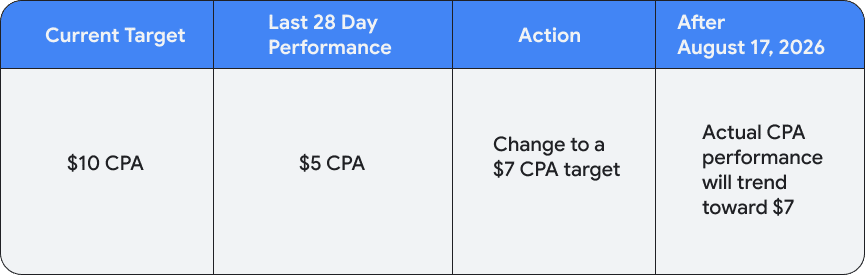
A campaign has a $10 Target CPA, but it has recently generated conversions at an actual $5 CPA. Today, a budget constraint may be contributing to that stronger-than-target efficiency. After August 17, Google says the campaign will be more likely to deliver toward the $10 CPA you entered.

That means advertisers should not assume an existing target simply represents a maximum threshold that Google will continue trying to beat.
If $5 is the CPA the business actually needs, the target may need to move closer to $5. If $7 is profitable and provides more room to scale, a $7 target could make more sense. The right answer depends on business economics rather than historical campaign settings alone.
For Performance Max and Demand Gen campaigns, Google also warns that advertisers may see changes in how traffic is distributed among channels as the bidding system adjusts.
How to Access the Bid Target Adjustment Tool
Google’s Bid Target Adjustment Tool is now available in Google Ads. The current help documentation provides two ways to access it.
Option 1: From Your Google Ads Notification
- Sign in to Google Ads.
- Find the “Review your campaign targets” notification banner or open the Notifications menu.
- Select Review campaigns to launch the Bid Target Adjustment Tool.
Option 2: From the Campaigns Page
- Open Campaigns in Google Ads.
- Find the campaign you want to review and open its settings.
- Select Bidding.
- Click Review campaigns to open the Target Adjustment Tool.
Google says the tool shows historical performance and allows advertisers to apply updated targets based on that performance. Google will not automatically change campaign targets or budgets ahead of the August 17 update.
What Should Advertisers Do Before August 17?
Start by identifying campaigns that meet both conditions:
- They use a target-based bid strategy such as Target CPA or Target ROAS.
- They have been Limited by budget and are outperforming their stated target.
Those are the campaigns most likely to require attention before the change.
From there, advertisers have several options.
Keep the Existing Target
If the current CPA or ROAS target accurately represents your business goal, you may not need to change anything.
Just understand that a campaign currently beating that target may begin performing closer to it after August 17.
Match the Target to Recent Performance
If you want to preserve recent efficiency, Google recommends using the Bid Target Adjustment Tool to move the target closer to actual historical performance.
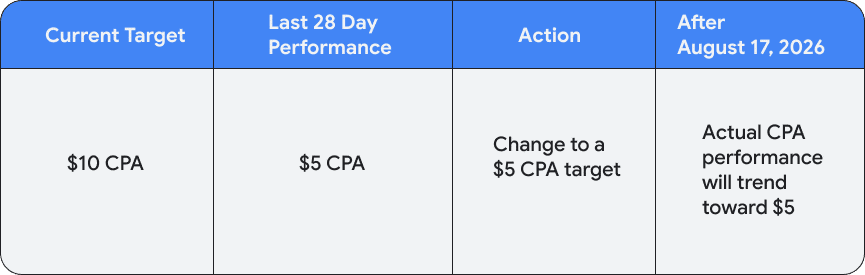
For example, a campaign producing a $5 CPA against a $10 Target CPA could have its target adjusted to $5.
Choose a New Target Based on Business Goals
Recent performance does not automatically equal the best target.
If a campaign is achieving a $5 CPA but your economics support a $7 CPA, using a $7 target could give the system additional flexibility while still staying within an acceptable profitability range. Google specifically allows advertisers to enter a custom target rather than simply adopting the tool’s suggested adjustment.
Increase the Campaign Budget
One potential benefit of the update is more predictable scaling.
Google says that after August 17, limited-budget campaigns should be able to increase spend while remaining more consistent with their stated targets. Google recommends giving profitable campaigns enough budget to scale and evaluating performance over one to two conversion cycles after making budget increases.
One Forecasting Caveat to Watch
Google’s FAQ notes that Performance Planner and other planning tools will be updated for the new bidding behavior starting August 17. Google warns there may be some forecast inaccuracies during the transition period from August 17 through August 31, 2026.
Advertisers making major budget decisions during that window should keep this transition period in mind instead of relying on forecasts in isolation.
Key Takeaways
- Google’s target-based bidding changes take effect August 17, 2026.
- The update primarily matters for Limited by budget campaigns using Target CPA, Target ROAS, or other impacted target-based bidding strategies.
- Campaigns currently outperforming their targets may begin delivering closer to the targets actually entered.
- The Bid Target Adjustment Tool is now live and can be accessed through account notifications or campaign bidding settings.
- Google will not automatically change targets or budgets.
- Review the gap between your stated target and actual performance before deciding whether to keep, lower, or customize a target.
- Performance Max and Demand Gen advertisers should also watch for changes in channel allocation.
What This Means for PPC Advertisers
This update makes the target you enter more consequential.
Historically, some limited-budget campaigns could substantially outperform their stated CPA or ROAS targets. After August 17, advertisers should expect Google to treat those targets more like the performance goals they are intended to be.
Before the update rolls out, review every affected campaign and ask a simple question: If Google actually delivers at this target, will the campaign still meet our business goals?
If the answer is no, now is the time to adjust it.
Helpful links for this Google update
Learn more about past Google updates
- Oct 2026 - October 2026 Google Ads Update – New Channel Prioritization and Budget Allocation Controls
- Oct 2026 - October 2026 Google Ads Update – Demand Gen Data Strength Improvements
- Oct 2026 - October 2026 Google Ads Update – Demand Gen Changes View-Through Conversion Reporting
- Oct 2026 - October 2026 Google Ads Update – Automated Promotions from Your Website
- Oct 2026 - October 2026 Google Ads Update – Business Name Policy Gets More Flexible
- Sep 2026 - September 2026 Google Ads Update – Demand Gen Adds Faster Paths to Conversion
- Sep 2026 - September 2026 Google Ads Update – AI Max Adds Languages and Journey Reporting
- Sep 2026 - September 2026 Google Ads Update – Agentic Holiday Commerce
- Sep 2026 - September 2026 Google Ads Update – New Measurement Tools
- Aug 2026 - August 2026 Google Ads Update – Demand Gen Adds New Ways to Drive Leads and Sales
- Aug 2026 - August 2026 Google Ads Update – New AI Max Testing Tools
- Aug 2026 - August 2026 Google Ads Update – Demand Gen VTC Bidding Changes
- Aug 2026 - August 2026 Google Ads Update – Language Targeting Simplified
- Aug 2026 - August 2026 Google Ads Update – New AI Tools Turn Insights Into Action
- Jul 2026 - July 2026 Google Ads Update – Holiday Demand Gen Tools
- Jul 2026 - July 2026 Google Ads Update – Video Campaign Group Controls
- Jul 2026 - July 2026 Google Ads Update – Google Expands AI Transparency Across Ads
- Jul 2026 - August 2026 Google Ads Update – Target Bidding Gets More Predictable
- Jun 2026 - June 2026 Google Ads Update – YouTube Brand Campaign Measurement Gets Stronger
- Jun 2026 - June 2026 Google Ads Update – Demand Gen Drop Adds AI Creative Tool
- Jun 2026 - June 2026 Google Ads Update – Financial Verification Expands Across Europe
- Jun 2026 - June 2026 Google Ads Update – YouTube Adds Gemini Creator Insights