
August 2026 Google Ads Update – New AI Tools Turn Insights Into Action
Introduced
Aug 10, 2026
Impact Rating
 Medium
Granular analysis and first look
Google Expands AI Across Ads and Analytics
Google is adding more AI-powered analysis and reporting tools to Google Ads and Google Analytics, building on the Ask Advisor experience introduced earlier this year. For advertisers working with PPC management services, these updates could reduce time spent digging through reports and make it easier to identify where human analysis should go deeper.
The bigger shift is not simply more AI-generated recommendations. Google is creating a more connected workflow where marketers can identify a change, investigate it and potentially act on it without jumping between as many reports or platforms.
AI Insights Are Coming to the Homepage
Google Analytics now includes AI Overviews at the top of the homepage that summarize important changes since a user’s last visit. These can highlight developments such as traffic shifts or seasonal sales patterns and provide context around what may deserve attention.
When an Analytics data card raises a question, marketers can send that context directly into Ask Advisor for deeper analysis. Users can also opt into phone or email notifications for these summaries at their preferred frequency.
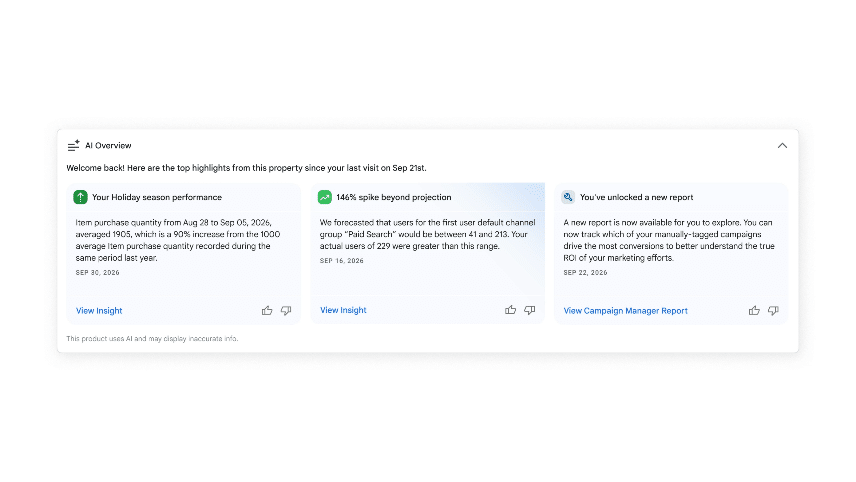
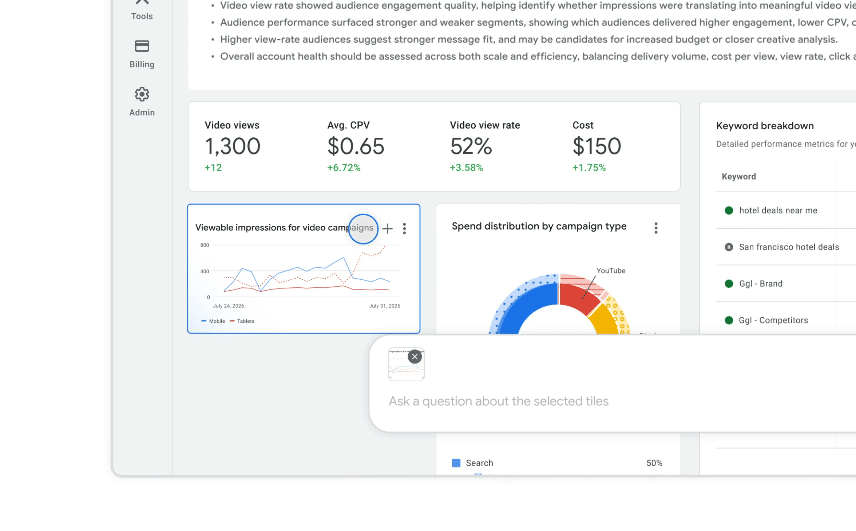
Google Ads is getting a similar treatment. Its redesigned homepage surfaces personalized AI-powered insight cards, along with a prompt box that lets advertisers request custom analysis based on what they want to investigate. Google specifically gives examples such as examining competitor effects on impression share or identifying trends that could improve campaign performance.
What This Means for PPC Teams
This could make account monitoring more efficient, especially for teams managing multiple campaigns or clients.
Instead of reviewing every metric manually to find unusual movement, AI can help point analysts toward areas that deserve attention. The important distinction is that these insights should serve as a starting point for investigation, not the final strategic decision.
Marketers still need to determine whether a change is meaningful, what caused it and whether taking action supports the advertiser’s broader business goals.
Google Ads Adds Prompt-Based Dashboards
Google is also introducing new Dashboards in Google Ads, with the feature planned for Google Analytics as well. Marketers can use natural-language prompts to turn campaign data into visual reports.
Google says each report will include a real-time summary designed to explain the “why” behind the performance data.
For PPC teams, this could make ad hoc reporting faster. Instead of manually configuring every table or visualization, advertisers may be able to describe the question they want answered and let the platform build an initial view.
Potential use cases include:
- Investigating sudden performance changes
- Comparing campaign trends
- Building quick stakeholder reports
- Identifying areas for deeper analysis
- Supporting campaign planning discussions
The value will depend on whether the generated visualization answers the right business question. Faster reporting is useful, but a polished chart can still lead to the wrong conclusion if the measurement framework or underlying data is incomplete.
Ask Advisor Adds Campaign Benchmarking
Google Analytics is also adding benchmarking capabilities to Ask Advisor. The feature compares campaign performance against anonymized averages from similar businesses.
That can give advertisers another directional signal when evaluating performance. For example, a marketer could use benchmarking to identify an area where campaigns appear to have more room for growth.
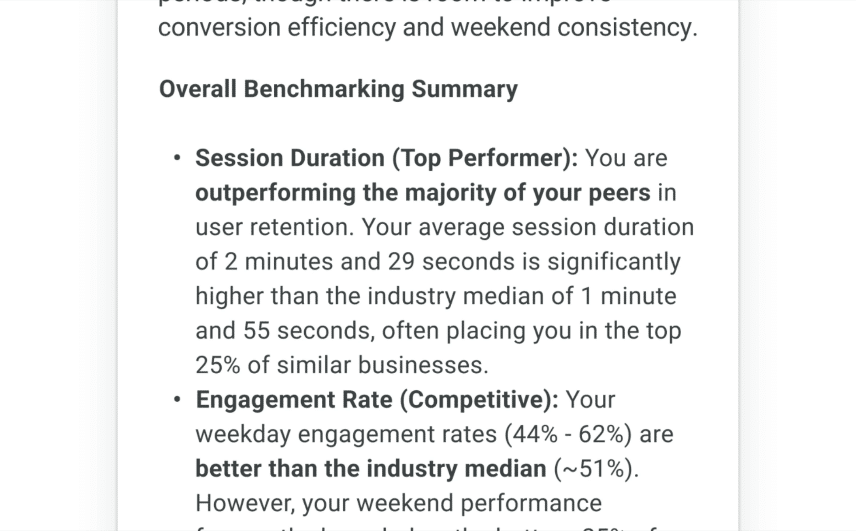
However, benchmarks should be treated as context rather than a universal performance target.
Two businesses in the same category can have very different margins, conversion values, customer acquisition costs and growth priorities. An advertiser outperforming an industry benchmark can still be unprofitable, while one below a benchmark could be meeting its specific business goals.
Ask Advisor Is Becoming a Larger Part of Google’s Workflow
Google introduced Ask Advisor in May 2026 as a cross-product AI experience connecting tools including Google Ads, Google Analytics and Merchant Center. It is designed to surface insights, make recommendations and help marketers complete tasks across the campaign journey.
These August updates make that direction clearer.
Google is increasingly positioning its AI as a layer between marketers and the traditional platform interface. Instead of finding a report, configuring it and interpreting it manually, marketers can increasingly start with a question and let the platform gather the relevant information.
That could create significant time savings, but it also makes strong measurement strategy more important. AI can analyze the data it receives; marketers still need to make sure the right conversions, values and business outcomes are being measured in the first place.
Key Takeaways
- Google announced new AI and agentic capabilities across Google Ads and Google Analytics on August 10, 2026.
- Google Analytics now surfaces AI Overviews highlighting important performance changes.
- Google Ads is adding personalized AI insight cards and a prompt box for custom analysis.
- New Google Ads Dashboards can turn natural-language prompts into visual reports and performance summaries.
- Ask Advisor in Google Analytics is adding benchmarking against anonymized averages from similar businesses.
- Google is continuing to connect reporting, analysis and action through its Ask Advisor experience.
- Advertisers should use AI-generated insights to accelerate analysis while still validating recommendations against business goals and reliable measurement.
What This Means for PPC Advertisers
Google’s newest AI tools are less about adding another chatbot and more about changing how advertisers interact with campaign data.
The opportunity is speed. If these tools can reliably flag performance changes, build useful reports and provide relevant context, PPC teams can spend less time navigating interfaces and more time deciding what those insights mean.
But easier analysis does not eliminate the need for expertise. Knowing which question to ask, whether the answer makes sense and what action is right for the business remains the critical part of campaign management.
The advertisers who benefit most will likely be those who use Google’s AI to accelerate the repetitive parts of analysis without outsourcing the strategy behind the decision.
Helpful links for this Google update
Learn more about past Google updates
- Oct 2026 - October 2026 Google Ads Update – New Channel Prioritization and Budget Allocation Controls
- Oct 2026 - October 2026 Google Ads Update – Demand Gen Data Strength Improvements
- Oct 2026 - October 2026 Google Ads Update – Demand Gen Changes View-Through Conversion Reporting
- Oct 2026 - October 2026 Google Ads Update – Automated Promotions from Your Website
- Oct 2026 - October 2026 Google Ads Update – Business Name Policy Gets More Flexible
- Sep 2026 - September 2026 Google Ads Update – Demand Gen Adds Faster Paths to Conversion
- Sep 2026 - September 2026 Google Ads Update – AI Max Adds Languages and Journey Reporting
- Sep 2026 - September 2026 Google Ads Update – Agentic Holiday Commerce
- Sep 2026 - September 2026 Google Ads Update – New Measurement Tools
- Aug 2026 - August 2026 Google Ads Update – Demand Gen Adds New Ways to Drive Leads and Sales
- Aug 2026 - August 2026 Google Ads Update – New AI Max Testing Tools
- Aug 2026 - August 2026 Google Ads Update – Demand Gen VTC Bidding Changes
- Aug 2026 - August 2026 Google Ads Update – Language Targeting Simplified
- Aug 2026 - August 2026 Google Ads Update – New AI Tools Turn Insights Into Action
- Jul 2026 - July 2026 Google Ads Update – Holiday Demand Gen Tools
- Jul 2026 - July 2026 Google Ads Update – Video Campaign Group Controls
- Jul 2026 - July 2026 Google Ads Update – Google Expands AI Transparency Across Ads
- Jul 2026 - August 2026 Google Ads Update – Target Bidding Gets More Predictable
- Jun 2026 - June 2026 Google Ads Update – YouTube Brand Campaign Measurement Gets Stronger
- Jun 2026 - June 2026 Google Ads Update – Demand Gen Drop Adds AI Creative Tool
- Jun 2026 - June 2026 Google Ads Update – Financial Verification Expands Across Europe
- Jun 2026 - June 2026 Google Ads Update – YouTube Adds Gemini Creator Insights