
July 2026 Google Ads Update – Google Expands AI Transparency Across Ads
Introduced
Jul 09, 2026
Impact Rating
 Medium
Granular analysis and first look
Google is making AI-generated advertising easier for users to identify by introducing new disclosure tools across Search, YouTube and Discover. For advertisers using AI at scale, Google Ads management will increasingly need to include asset-labeling and compliance workflows alongside creative testing and optimization.
The central addition is a “How this ad was made” section within My Ad Center. Users can access it by selecting the three-dot menu or information icon on an eligible ad to see whether AI was used to create or edit its assets. How Google’s AI Ad Disclosures Work
The disclosure process depends on where the creative was produced.
Assets Created With Google AI
When advertisers use Google’s generative AI advertising tools, Google will automatically add an AI disclosure to the ad’s My Ad Center panel. Google may also apply labels when its systems receive relevant signals from other platforms or when labeling is legally required.
Advertisers cannot overwrite labels that Google applies automatically. Assets Created With Outside AI Tools
For assets created or altered using third-party generative AI tools, Google is adding an advertiser-controlled AI label setting. Advertisers can designate an asset as created or edited with AI during campaign creation or through the Asset Library.
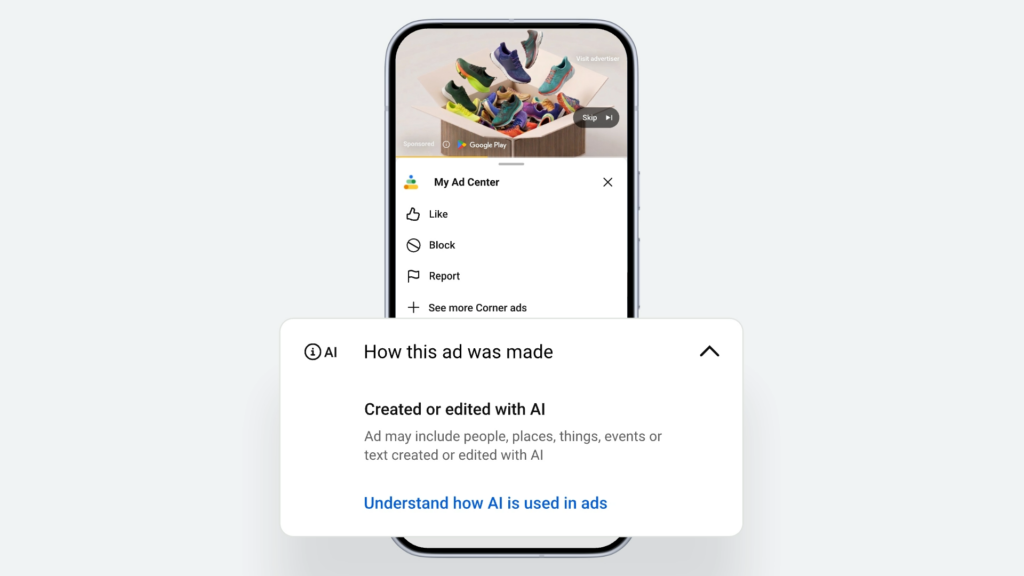
The setting is scheduled to roll out gradually throughout July across Google Ads, Display & Video 360, Campaign Manager 360, Merchant Center and Google Ads Editor. Where Users May See AI Labels
The “How this ad was made” disclosure will be available globally through My Ad Center for qualifying ads across:
- Google Search
- YouTube
- Discover
In some markets, the disclosure may also appear directly on the ad instead of only within My Ad Center. Google currently identifies the European Union, India and New York as locations where certain AI-created or edited ad assets may require visible overlays. Disclosure requirements can vary by region and content type. gle also notes that using its AI label setting does not automatically guarantee compliance with every applicable regulation. Advertisers remain responsible for evaluating their legal and platform-specific disclosure obligations.
What This Means for PPC Advertisers
This update is unlikely to change campaign performance directly, but it introduces another important layer of creative governance.
The biggest risk is not the presence of an AI label. It is failing to know how an asset was produced, where it will run or whether it requires disclosure. That becomes more complicated when creative moves between internal teams, agencies, freelancers and third-party production platforms.
Advertisers should prepare by taking the following steps:
- Inventory AI-assisted assets: Identify which images, videos and other creative elements were generated or materially edited with AI.
- Document asset sources: Record whether each asset came from Google’s tools, an outside platform or a traditional production process.
- Assign disclosure ownership: Establish who is responsible for reviewing and applying AI labels before campaigns launch.
- Review geographic targeting: Pay particular attention to campaigns serving regions with direct on-ad disclosure requirements.
- Add labeling to creative QA: Treat AI status like landing-page URLs, trademarks and policy compliance—a required pre-launch check.
AI Labels Do Not Replace Existing Ad Policies
Google’s existing advertising policies still apply regardless of how an ad was created. AI-generated ads remain subject to the same rules covering misrepresentation, deceptive claims and prohibited content as traditionally produced ads. s distinction matters. An AI disclosure tells users how the creative was made; it does not confirm that the ad’s claims are accurate, compliant or representative of the actual product.
Advertisers should continue reviewing AI outputs for fabricated product details, unrealistic imagery, inaccurate pricing and unsupported claims before approving them for use.
Key Takeaways
- Google is adding a “How this ad was made” section to My Ad Center.
- Disclosures can identify ads created or edited with generative AI.
- Assets produced with Google’s AI tools may be labeled automatically.
- Advertisers can label assets created with third-party AI tools.
- Certain markets may require labels to appear directly on the ad.
- AI labeling should become part of every advertiser’s creative QA process.
- Existing Google Ads policies still apply to all AI-generated content.
Google’s new AI transparency features are another sign that generative creative is moving from experimentation into standard advertising operations. As AI-generated assets become easier to produce, advertisers will need stronger systems for documenting where creative came from, reviewing how it represents the business and applying the correct disclosures.
The immediate campaign impact may be limited, but the operational impact is meaningful. Advertisers that establish clear AI labeling and approval processes now will be better prepared as platform requirements and regional regulations continue to evolve.
Helpful links for this Google update
Learn more about past Google updates
- Oct 2026 - October 2026 Google Ads Update – New Channel Prioritization and Budget Allocation Controls
- Oct 2026 - October 2026 Google Ads Update – Demand Gen Data Strength Improvements
- Oct 2026 - October 2026 Google Ads Update – Demand Gen Changes View-Through Conversion Reporting
- Oct 2026 - October 2026 Google Ads Update – Automated Promotions from Your Website
- Oct 2026 - October 2026 Google Ads Update – Business Name Policy Gets More Flexible
- Sep 2026 - September 2026 Google Ads Update – Demand Gen Adds Faster Paths to Conversion
- Sep 2026 - September 2026 Google Ads Update – AI Max Adds Languages and Journey Reporting
- Sep 2026 - September 2026 Google Ads Update – Agentic Holiday Commerce
- Sep 2026 - September 2026 Google Ads Update – New Measurement Tools
- Aug 2026 - August 2026 Google Ads Update – Demand Gen Adds New Ways to Drive Leads and Sales
- Aug 2026 - August 2026 Google Ads Update – New AI Max Testing Tools
- Aug 2026 - August 2026 Google Ads Update – Demand Gen VTC Bidding Changes
- Aug 2026 - August 2026 Google Ads Update – Language Targeting Simplified
- Aug 2026 - August 2026 Google Ads Update – New AI Tools Turn Insights Into Action
- Jul 2026 - July 2026 Google Ads Update – Holiday Demand Gen Tools
- Jul 2026 - July 2026 Google Ads Update – Video Campaign Group Controls
- Jul 2026 - July 2026 Google Ads Update – Google Expands AI Transparency Across Ads
- Jul 2026 - August 2026 Google Ads Update – Target Bidding Gets More Predictable
- Jun 2026 - June 2026 Google Ads Update – YouTube Brand Campaign Measurement Gets Stronger
- Jun 2026 - June 2026 Google Ads Update – Demand Gen Drop Adds AI Creative Tool
- Jun 2026 - June 2026 Google Ads Update – Financial Verification Expands Across Europe
- Jun 2026 - June 2026 Google Ads Update – YouTube Adds Gemini Creator Insights