
May 2026 Google Ads Update – Google Unifies Data and Measurement
Introduced
May 20, 2026
Impact Rating
 Medium
Granular analysis and first look
Google Strengthens Its Measurement Foundation for AI
Google’s May 5, 2026, announcement focuses on a critical requirement for AI-powered advertising: reliable data. For businesses using Google Ads management services, the update introduces new ways to understand data connections, improve tagging, conduct geographic experiments and scale marketing mix modeling.
The announcement includes four notable developments:
- A new Data Manager map view
- A visual upgrade process for the Google tag
- Meridian GeoX for geographic incrementality testing
- Meridian Studio for enterprise marketing mix modeling
Several of these capabilities are planned for future rollout or testing rather than immediate general availability.
Data Manager Will Visualize Data Connections
Google plans to introduce a new summary and map view in Data Manager in the coming months. The interface will show how information flows from platforms such as BigQuery, Google Drive, HubSpot and Shopify into Google’s advertising and analytics products.
The goal is to give advertisers a clearer view of the data powering Google Ads, Google Analytics and Google Marketing Platform.
This could make it easier to identify:
- Missing or disconnected data sources
- Incorrect connection paths
- Duplicate integrations
- Configuration gaps
- Signals available to some platforms but not others
For agencies and advertisers managing complex technology stacks, the visual map may reduce the time required to diagnose why a particular audience, conversion or customer-data source is unavailable.
Data Manager Will Support Richer Customer Signals
Google also plans to expand Data Manager and its API so advertisers can combine foundational website tags with additional information, including store-sales data. The update is expected to begin rolling out in the coming weeks.
Bringing these signals together could give advertisers a more complete view of the customer journey, especially when purchases occur both online and offline.
However, connecting more data does not automatically improve campaign performance. Businesses will still need to confirm that:
- Data is collected consistently.
- Conversion definitions match business outcomes.
- Offline transactions are attributed accurately.
- Customer information is handled with appropriate permissions.
- Low-value and high-value actions are distinguished.
The quality and meaning of the data remain more important than the number of connections.
Google Tag Setup Is Becoming More Visual
Google is upgrading the Google tag with a new visual setup experience. Advertisers with existing tags will not need to install an entirely new tag; Google says they will be able to upgrade their current implementation with a few clicks and without coding.
The update will also extend Google Tag Manager-style capabilities more broadly by centralizing settings and user access.
This may help smaller organizations improve tag governance without requiring extensive developer support. Larger advertisers should still test changes carefully, particularly when multiple platforms, consent tools or custom events depend on the same implementation.
Google reports that advertisers using Google tag gateway experience an average 14% conversion lift. That is an aggregated Google result rather than a guarantee for an individual account, so advertisers should evaluate the impact using their own conversion data and implementation conditions.
Meridian GeoX Will Test Geographic Incrementality
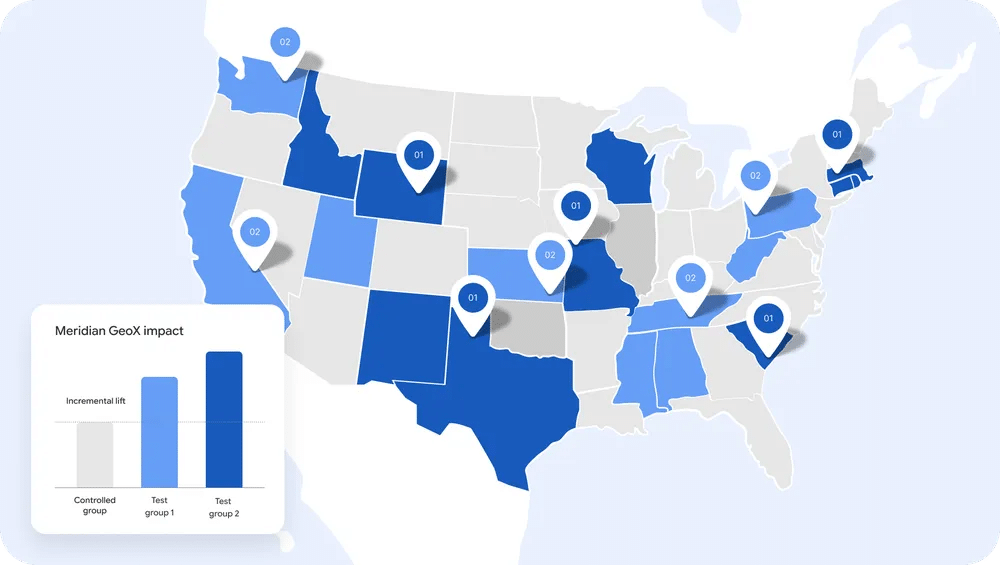
Google is adding Meridian GeoX to its measurement portfolio. The open-source tool is designed to help advertisers run geographic experiments and estimate whether media activity caused incremental results in selected locations. Testing is scheduled to begin later in 2026.
A geo-experiment typically divides comparable markets into test and control groups. The advertiser changes media investment in the test regions and compares the resulting business performance with the control regions.
This can help answer questions that platform attribution alone may not resolve, such as:
- Did increasing media spend generate additional sales?
- Would those conversions have happened without the advertising?
- Which channels are producing incremental growth?
- Does a campaign affect offline or regional performance?
- How should future budgets be distributed?
Google says GeoX signals will integrate with Meridian, its open-source marketing mix model. That connection is intended to help advertisers calibrate broader modeling with experimental evidence.
Meridian Studio Will Help Enterprises Scale MMMs
Google is also launching Meridian Studio, an enterprise platform built on Google Cloud. It is designed for sophisticated measurement teams that need to customize, manage and run large volumes of marketing mix models.
Marketing mix modeling can help businesses estimate the contribution of different marketing channels using aggregated historical data. It can be valuable when user-level attribution is incomplete or when a company invests across digital and offline media.
Meridian Studio is intended to reduce the operational work involved in:
- Managing multiple models
- Incorporating richer data sources
- Repeating analyses across markets or brands
- Applying consistent modeling methods
- Updating models as new performance data becomes available
The platform is most relevant to organizations with sufficient data, analytical resources and media scale. Smaller advertisers may gain more immediate value from accurate conversion tracking and structured experiments before investing in advanced MMM programs.
Why Causal Measurement Matters
Google’s announcement draws a distinction between observing performance and proving causality.
Attribution platforms can report that a conversion happened after an ad interaction. Incrementality experiments attempt to determine whether the ad caused an outcome that would not otherwise have occurred. Marketing mix models then provide a broader framework for evaluating investments across channels and time.
These approaches should complement one another:
- Attribution: Provides frequent campaign-level feedback.
- Experiments: Test whether specific activity caused incremental outcomes.
- Marketing mix modeling: Evaluates broader investment patterns.
- Business data: Confirms whether advertising contributed to revenue or profit.
No single measurement method provides a complete answer. Advertisers will generally make stronger decisions by comparing multiple signals rather than treating one attribution report as definitive.
What Advertisers Should Do Next
Audit Current Data Connections
Before adopting new measurement tools, advertisers should document the information currently entering Google Ads and Analytics.
Review:
- Website and app tags
- Primary and secondary conversions
- CRM integrations
- Enhanced conversions
- Offline conversion imports
- Store-sales data
- Merchant Center connections
- Analytics and BigQuery exports
This creates a baseline for evaluating Data Manager’s upcoming map view.
Review Tag Governance
Confirm who can modify tags, how changes are approved and whether legacy implementations are still active. The new visual setup may simplify deployment, but it should not replace governance and quality assurance.
Identify Incrementality Questions
Advertisers should define the business questions they want experiments to answer before selecting a testing tool.
A useful question is specific and connected to a decision, such as:
“Would increasing YouTube investment in selected markets generate incremental qualified leads at an acceptable cost?”
That is more actionable than broadly asking whether advertising “works.”
Prepare Data for Marketing Mix Modeling
Organizations considering Meridian Studio should evaluate whether they have enough consistent historical data across spend, outcomes, pricing, promotions and external business factors.
Models built on incomplete or inconsistently defined inputs may produce precise-looking results that are not strategically reliable.
Key Takeaways
- Data Manager will introduce a visual map of advertising and analytics connections.
- Data Manager and its API will support additional signals, including store sales.
- Existing Google tags will gain a no-code visual upgrade path.
- Meridian GeoX will support open-source geographic incrementality experiments.
- Meridian Studio will help enterprise teams build and manage marketing mix models at scale.
- Advertisers should combine attribution, experiments and modeling rather than relying on one measurement method.
- Several announced features are rolling out later or entering testing in 2026.
Google is positioning measurement as the foundation of AI-powered campaign growth. As bidding, targeting and creative production become more automated, advertisers need stronger ways to verify that platform activity is producing incremental business results.
The new tools may reduce technical complexity, but they do not remove the need for sound measurement strategy. Accurate conversion definitions, disciplined experiments and reliable business data will determine whether advertisers can turn Google’s expanding AI capabilities into defensible growth.
Helpful links for this Google update
Learn more about past Google updates
- Sep 2026 - September 2026 Google Ads Update – Demand Gen Adds Faster Paths to Conversion
- Sep 2026 - September 2026 Google Ads Update – AI Max Adds Languages and Journey Reporting
- Sep 2026 - September 2026 Google Ads Update – Agentic Holiday Commerce
- Sep 2026 - September 2026 Google Ads Update – New Measurement Tools
- Aug 2026 - August 2026 Google Ads Update – Demand Gen Adds New Ways to Drive Leads and Sales
- Aug 2026 - August 2026 Google Ads Update – New AI Max Testing Tools
- Aug 2026 - August 2026 Google Ads Update – Demand Gen VTC Bidding Changes
- Aug 2026 - August 2026 Google Ads Update – Language Targeting Simplified
- Aug 2026 - August 2026 Google Ads Update – New AI Tools Turn Insights Into Action
- Jul 2026 - July 2026 Google Ads Update – Holiday Demand Gen Tools
- Jul 2026 - July 2026 Google Ads Update – Video Campaign Group Controls
- Jul 2026 - July 2026 Google Ads Update – Google Expands AI Transparency Across Ads
- Jul 2026 - August 2026 Google Ads Update – Target Bidding Gets More Predictable
- Jun 2026 - June 2026 Google Ads Update – YouTube Brand Campaign Measurement Gets Stronger
- Jun 2026 - June 2026 Google Ads Update – Demand Gen Drop Adds AI Creative Tool
- Jun 2026 - June 2026 Google Ads Update – Financial Verification Expands Across Europe
- Jun 2026 - June 2026 Google Ads Update – YouTube Adds Gemini Creator Insights
- Jun 2026 - June 2026 Google Ads Update – Enhanced Local Services Ads for Home Listings bring homebuyers and local agents together
- Jun 2026 - June 2026 Google Ads Update – YouTube Shorts Earns MRC Brand Safety Accreditation
- May 2026 - May 2026 Google Ads Update – Ads Decoded Highlights AI’s Marketing Shift
- May 2026 - June 2026 Google Ads Update – Google Display Ads Move Into Demand Gen
- May 2026 - May 2026 Google Ads Update – Asset Studio Adds Multimodal Creative Tools