
February 2026 Google Ads Update – AI Search and Agentic Commerce
Introduced
Feb 11, 2026
Impact Rating
 Medium
Granular analysis and first look
Google Prepares Ads for an AI-First Commerce Journey
Google is reworking advertising around a customer journey that may begin with a conversational question, continue through an AI-generated recommendation and end with a purchase inside the same experience. For advertisers, Granular’s PPC management services can help connect these emerging placements with disciplined campaign structure, measurement and profitability goals.
Google outlined this direction in its February 11, 2026, annual Ads and Commerce letter. Importantly, several features discussed are tests, pilots or future expansions—not tools every advertiser can access today.
Ads Are Becoming Part of AI Mode
Google is testing a sponsored shopping format within AI Mode that highlights retailers selling products recommended in the organic response. Similar concepts are also being explored outside retail, including travel.
The strategic change is bigger than a new placement. Search ads may increasingly respond to complex, conversational intent rather than matching a traditional keyword query. Advertisers should prepare by improving product data, landing-page content and creative assets so Google’s systems can understand when their offering is relevant.
Google has already been testing ads below and within AI Mode responses in the United States, confirming that these AI-assisted searches represent incremental inventory rather than a purely organic experience.
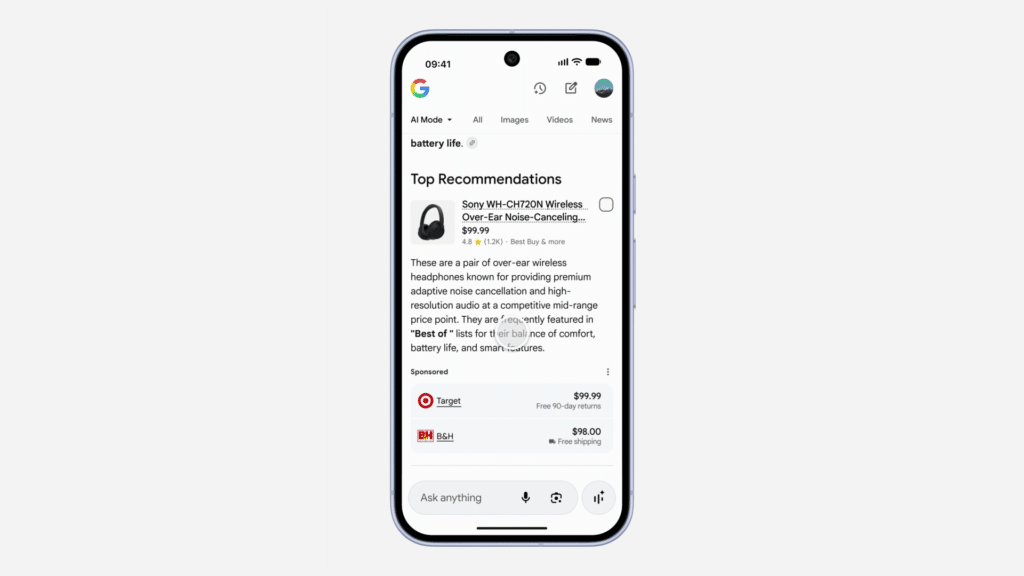
User flow of the new shopping format in AI Mode featured below organic results with a “Sponsored” label.
Direct Offers Could Personalize the Final Step
Google also highlighted Direct Offers, a monetization experience designed to present a tailored promotion when an AI Mode shopper appears ready to purchase. Future offers may include more than discounts, such as bundles or loyalty benefits.
For ecommerce advertisers, this increases the importance of offer strategy. Brands will need clear rules for margins, inventory and customer value before allowing automation to decide when a specialized incentive should appear.
Agentic Checkout Shortens the Purchase Journey
Google’s Universal Commerce Protocol, or UCP, is intended to standardize how retailers, payment providers and AI agents exchange information throughout the shopping process. Google says UCP-powered checkout is rolling out for purchases from Etsy and Wayfair inside AI Mode and Gemini, with Shopify, Target and Walmart expected to follow.
This could reduce friction between ad exposure and purchase, but it may also change what advertisers can observe on their own websites. Conversion tracking, transaction reconciliation and incrementality measurement will become increasingly important as more activity occurs within Google-controlled experiences.
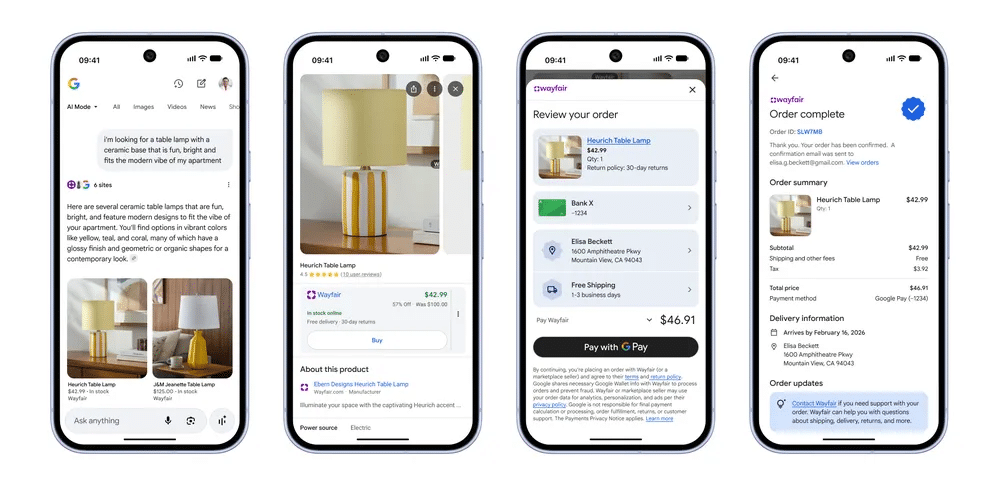
A step-by-step view of the UCP-powered shopping journey, illustrating how users can discover and purchase an item from Wayfair directly within AI Mode.
Gemini Expands Creative Production
Google says Gemini-powered tools are becoming a larger part of Asset Studio, AI Max and Performance Max. Advertisers can use tools including Nano Banana and Veo 3 to create and adapt image and video assets more quickly. Google reported that advertisers generated nearly 70 million creative assets with Gemini in AI Max and Performance Max during the fourth quarter of 2025.
Faster production does not eliminate the need for creative strategy. Advertisers should treat generative tools as a way to expand testing while maintaining brand standards, accurate claims and human review.
YouTube Creator Matching Gets More Automated
Google is also developing AI-assisted matching between advertisers and relevant YouTube creator communities. The goal is to make creator partnerships easier to source and connect organic influence with measurable advertising outcomes.
Brands should begin organizing creator permissions, usage rights and performance expectations now. A larger supply of creator content will only be useful when it can be tested against clear campaign objectives.
What Advertisers Should Do Next
The immediate priority is not to rebuild every campaign around unreleased features. Advertisers should strengthen the inputs these systems will rely on:
- Improve Merchant Center feeds and product attributes.
- Review margins before testing personalized promotions.
- Build a varied inventory of high-quality image and video assets.
- Strengthen first-party conversion and revenue data.
- Monitor AI Max and Performance Max for incremental reach—not simply higher reported volume.
- Separate confirmed product availability from Google’s longer-term roadmap.
Key Takeaways
- AI Mode is becoming a new commercial surface for both organic recommendations and sponsored placements.
- Direct Offers may let retailers deliver customized incentives near the point of purchase.
- UCP could enable more transactions to occur directly within Google and Gemini.
- Gemini is accelerating creative production across Google’s automated campaigns.
- Better product data, measurement and business inputs will matter more as campaign execution becomes increasingly automated.
Google’s 2026 roadmap points toward a more compressed customer journey: discovery, comparison, promotion and checkout may all happen within an AI-assisted conversation. The opportunity is meaningful, but advertisers should avoid treating automation as a substitute for strategy.
The strongest accounts will pair Google’s expanding AI capabilities with reliable business data, deliberate creative testing and measurement that distinguishes true growth from platform-reported performance.
Helpful links for this Google update
Learn more about past Google updates
- Oct 2026 - October 2026 Google Ads Update – Financial Services Verification Expanding to U.S. and Canada
- Oct 2026 - October 2026 Google Ads Update – New Channel Prioritization and Budget Allocation Controls
- Oct 2026 - October 2026 Google Ads Update – Demand Gen Data Strength Improvements
- Oct 2026 - October 2026 Google Ads Update – Demand Gen Changes View-Through Conversion Reporting
- Oct 2026 - October 2026 Google Ads Update – Automated Promotions from Your Website
- Oct 2026 - October 2026 Google Ads Update – Business Name Policy Gets More Flexible
- Sep 2026 - September 2026 Google Ads Update – Demand Gen Adds Faster Paths to Conversion
- Sep 2026 - September 2026 Google Ads Update – AI Max Adds Languages and Journey Reporting
- Sep 2026 - September 2026 Google Ads Update – Agentic Holiday Commerce
- Sep 2026 - September 2026 Google Ads Update – New Measurement Tools
- Aug 2026 - August 2026 Google Ads Update – Demand Gen Adds New Ways to Drive Leads and Sales
- Aug 2026 - August 2026 Google Ads Update – New AI Max Testing Tools
- Aug 2026 - August 2026 Google Ads Update – Demand Gen VTC Bidding Changes
- Aug 2026 - August 2026 Google Ads Update – Language Targeting Simplified
- Aug 2026 - August 2026 Google Ads Update – New AI Tools Turn Insights Into Action
- Jul 2026 - July 2026 Google Ads Update – Holiday Demand Gen Tools
- Jul 2026 - July 2026 Google Ads Update – Video Campaign Group Controls
- Jul 2026 - July 2026 Google Ads Update – Google Expands AI Transparency Across Ads
- Jul 2026 - August 2026 Google Ads Update – Target Bidding Gets More Predictable
- Jun 2026 - June 2026 Google Ads Update – YouTube Brand Campaign Measurement Gets Stronger
- Jun 2026 - June 2026 Google Ads Update – Demand Gen Drop Adds AI Creative Tool
- Jun 2026 - June 2026 Google Ads Update – Financial Verification Expands Across Europe