Reverse Engineering the Algorithm: How Ads Know You
Recap from my talk at Data Driven Wisconsin – MSOE
When RJ Nowling asked me to give a talk on Granular’s behalf at the Data Driven Wisconsin conference, I told him we should chat first so I could better understand the type of audience him, Randy Kirk and the organizers of Data Driven Wisconsin have cultivated and expected to be at the 2025 event.
After chatting with RJ and learning more about the audience and hearing from him what he thought Granular had a unique perspective on, I landed on “Reverse-Engineering the Algorithm: How Ads Know You (and What That Reveals About AI)”.
Data Driven Wisconsin is an annual event that brings together a great mix of practitioners, executives, students, educators and others to discuss everything from philosophies to tactics to everything between related to data.
This year’s event was heavy on AI (mine included).
Eerie < Data Science
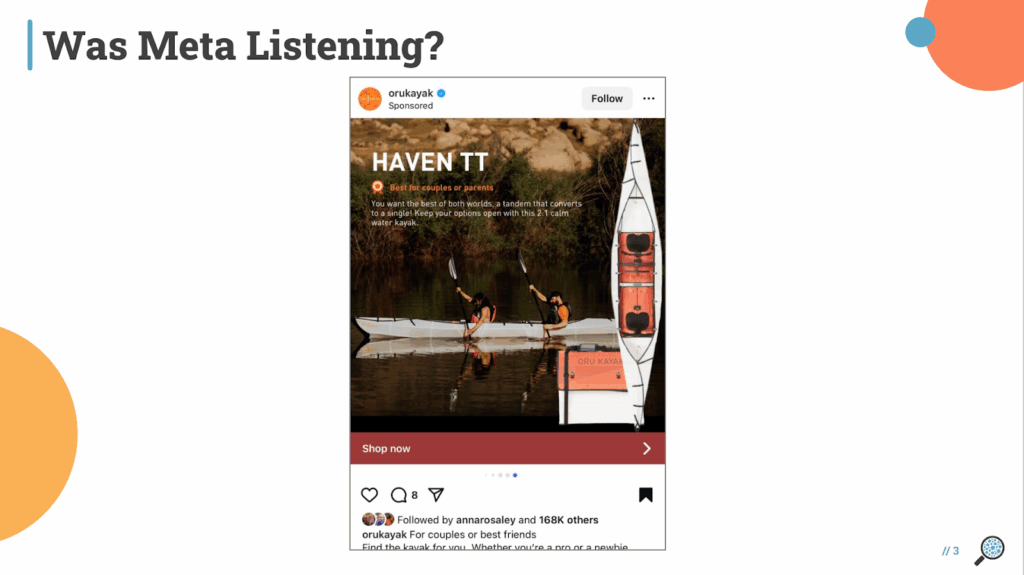
If you’ve ever mentioned a product out loud and then seen an ad for it hours later, you’ve probably wondered if your phone was listening. That’s how I opened my talk at 2025’s Data Driven Wisconsin at Milwaukee School of Engineering (MSOE). I showed a personal example: I said the word “kayak” and shortly after got served a foldable kayak ad on Instagram.
I don’t think Meta was listening. I think it was predicting.
The talk focused on how ad platforms like Google and Meta make these kinds of predictions. The short version: it’s not magic or surveillance. It’s machine learning, inference and a lot of data stitched together.
The Real Ad Tech Stack
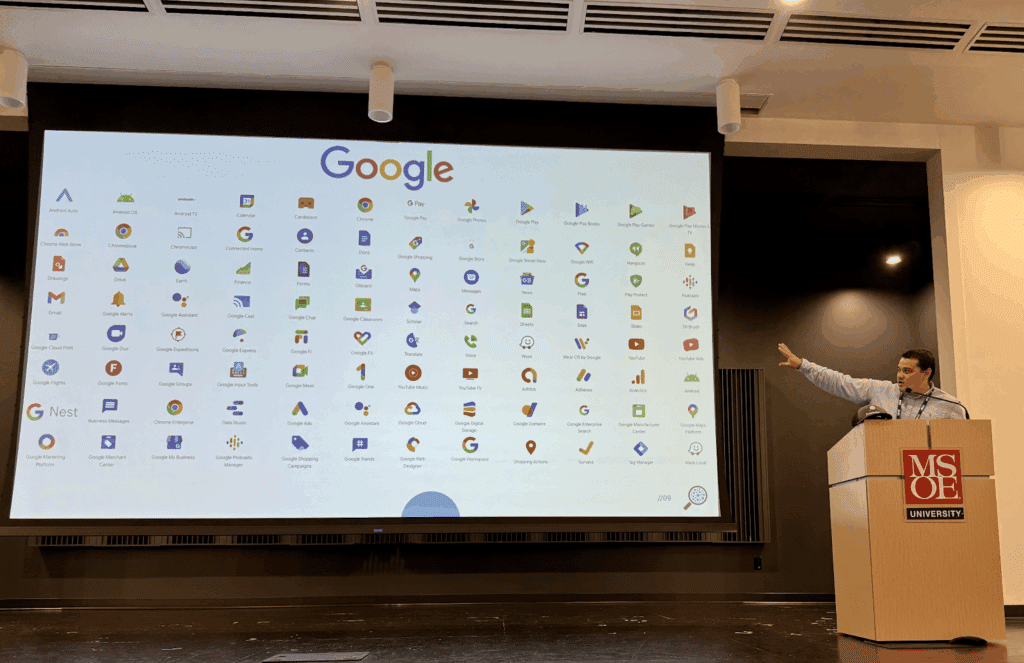
I walked through how platforms use both direct and passive signals to build a profile on you.
Google doesn’t need cookies. You’re logged into Gmail, YouTube, Chrome, Maps: all of that feeds into a giant first-party identity graph. They can see what you search, where you go, what you click, and when.
Meta goes further in some ways. Beyond the data you give it directly (likes, follows, views), it uses things like:
- Scroll behavior and engagement time
- Clipboard activity (yes, really)
- Location and proximity via your phone’s accelerometer
- Cross-app identity linking (Facebook, Instagram, WhatsApp)
- Pixel data from websites you visit
- Server-side events via the Conversions API
Put together, this becomes a behavioral mosaic. Some of it is accurate. Some of it isn’t.A 2022 study from NC State showed that roughly 30% of Facebook’s inferred interest tags were wrong. But when the other 70% are right, that’s enough to power billions in ad delivery.
What the Platforms Optimize For
Platforms like Meta and Google don’t optimize for your actual business results. They optimize for what they can measure and report.
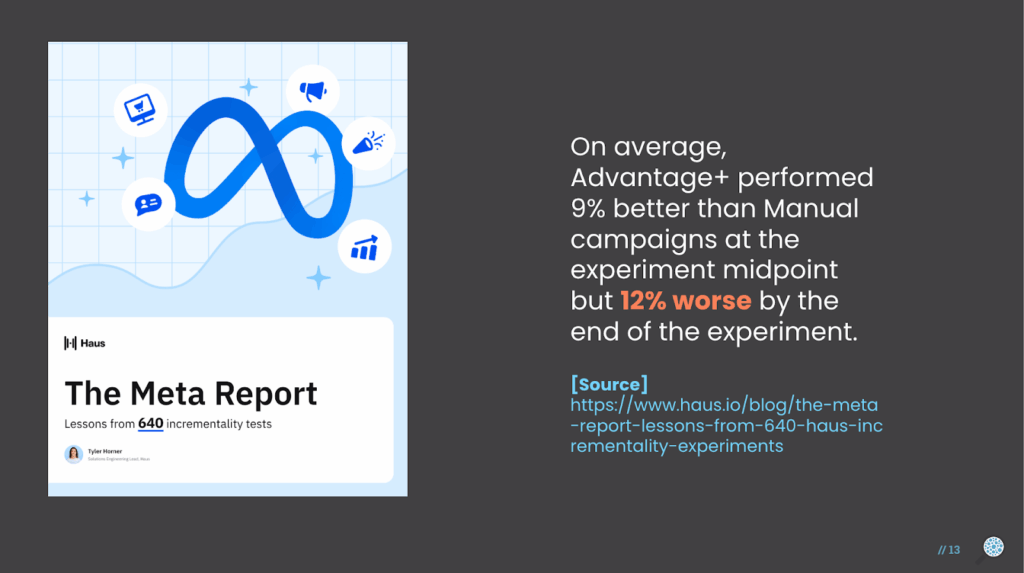
I shared a stat from Haus.io that came from 640 incrementality tests. Meta’s Advantage+ campaigns performed better than manually configured campaigns at first. But when measured for lift, they ended up underperforming by 12%.
That 12% difference is the gap between reported ROAS and real, incremental business value. You’re not just paying for outcomes. You’re paying for attribution: whether it’s deserved or not.
How to Check the Platform’s Work
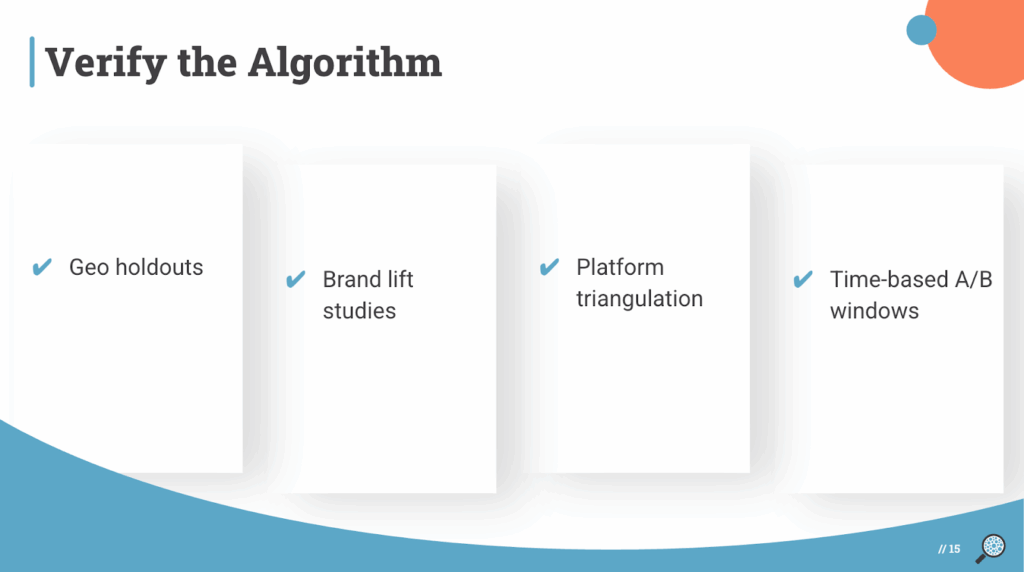
We’ve found that platforms will take as much credit as you give them. You need to push back with your own validation methods.
Some ways to do that:
- Geo holdout testing: Run ads in one city, hold out another
- Survey attribution: Ask customers how they found you
- Platform triangulation: Compare Meta reporting to GA4, MMM/MTA platforms and Shopify
- Look at pre/post performance: not just what the ad manager says
A Real Example: Incremental Lift From CTV
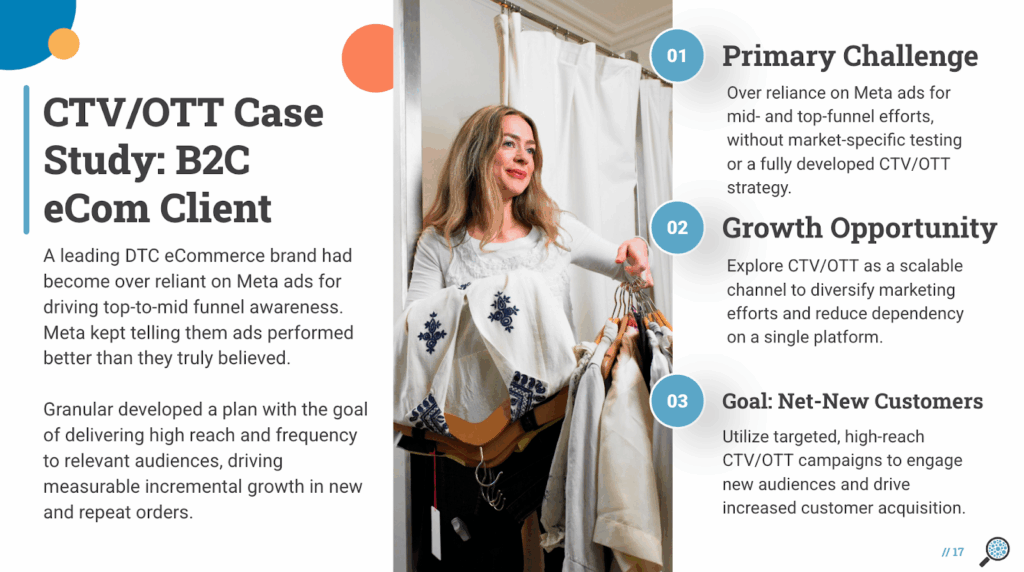
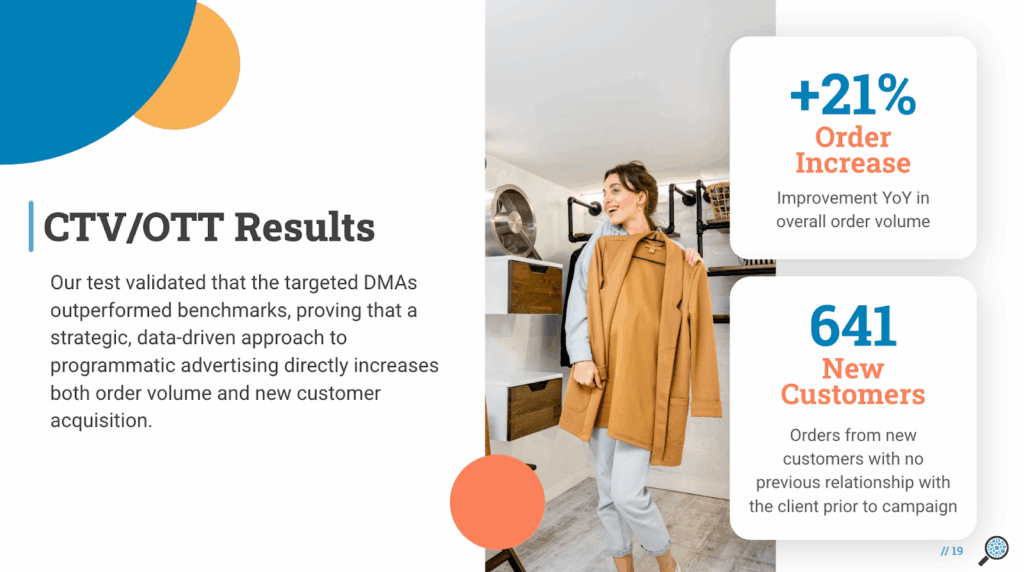
One of the examples I shared was a test we ran for a DTC ecomm brand. They were leaning hard into Meta but seeing diminishing returns. So we chose to ran a geo-based test where we held Meta spend steady but added Connected TV and YouTube in select markets.
In the test cities, we saw a 21% lift in orders and 641 net-new customers, people who hadn’t purchased before and weren’t in the retargeting pool. These were true incremental wins, not just re-attributed sales.
How We Use AI at Granular
This wasn’t the main point of the talk, but I gave a quick look at how we use AI internally at Granular. Some examples:
- Using agent-based workflows to augment competitive research
- Vision models to analyze ad creative patterns across Meta and Programmatic
- Analyzing performance and surfacing issues faster across platforms
We use AI to make our strategists faster and more informed.

The platforms don’t know you. They guess. But they’re good at it, because we feed them with behavior, history and intent.
As marketers, engineers, or analysts, your job isn’t to blindly trust the system. Your job is to understand how the guess is made, and how to test whether it’s actually working.
Thanks to MSOE and Data Driven Wisconsin for putting together a thoughtful and curious audience. Always great to talk with people who build things and want to understand how systems really work.
Questions?
If you have any questions or are interested in having Granular help grow your business, please use the button below to get in touch!
Related Articles