How Andromeda Changed Campaign Optimization (And What To Do About It)
Within the last year, you may have been hearing digital marketers talk more and more about Meta’s Andromeda update. Every time we read it, we still read “anaconda”, which arguably would have been a 10x cooler name.
Jokes aside, Andromeda represents a real shift in how Meta decides which ads get shown. If you run Meta campaigns, it’s already influencing which ads get delivered, which creatives scale, and which ones never even make it into the auction.
Before getting into how to optimize for it, it helps to understand what it actually is.
What is Andromeda
In late 2024, Meta rolled out Andromeda, the machine learning system that powers how ads are delivered and optimized across platforms like Facebook and Instagram.
In simple terms, this is the technology that helps Meta decide:
- Which ad to show
- Which person to show it to
- When to show it
- How likely that person is to take the action the advertiser is optimizing for
Andromeda does this by analyzing a massive amount of signals in real time, including:
- User behavior across Meta platforms
- Past ad interactions
- Device and location data
- Content engagement
- Conversion data from advertisers
The important thing to understand is that before Meta decides which ad wins the auction, the system first determines which ads are even worth considering for a specific person in a specific moment.
Andromeda acts as a retrieval engine that filters Meta’s vast ad inventory to produce a personalized shortlist of ads. If an ad doesn’t make this shortlist, it never reaches the auction.
Instead of a simple “winner takes all” system, Andromeda works more like a matching engine. It predicts which ads are meaningful to a user based on context and behavior, and the auction then determines which ultimately shows.
Not every ad is meant to directly drive a conversion, but every ad can contribute signals that help improve overall account performance.
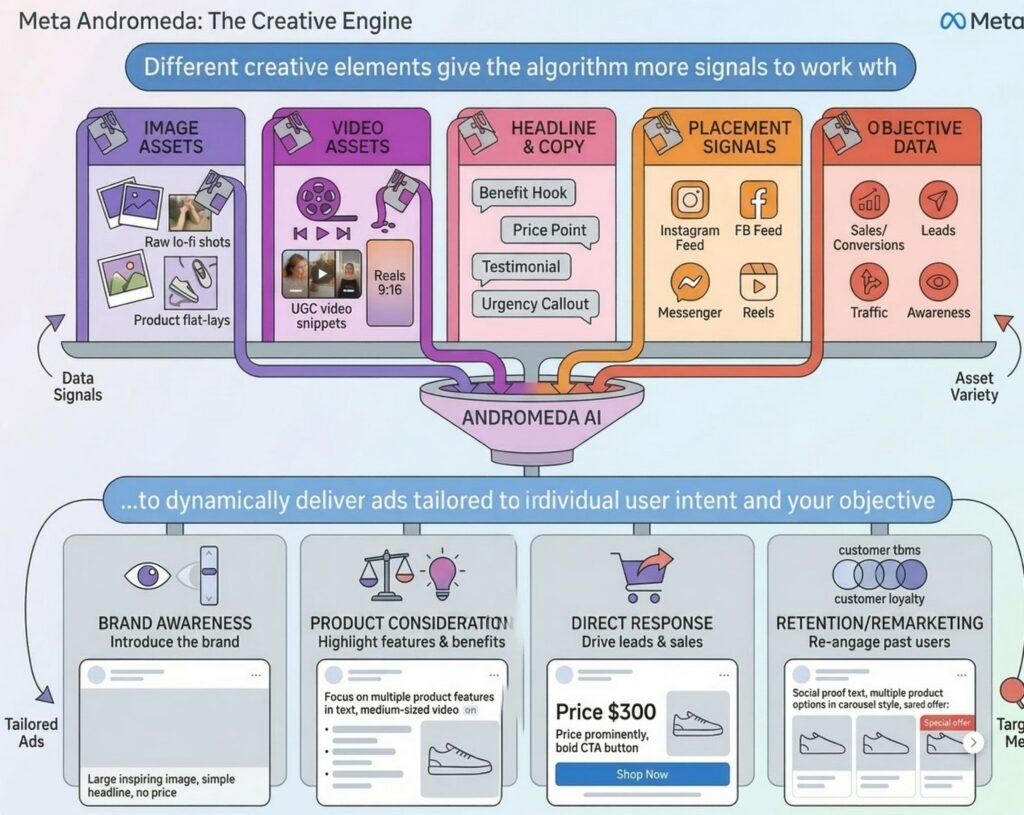
If you’re a visual learner, this diagram helps show how Andromeda works. Different creative inputs, signals, and objectives feed the system, which then decides which ads to deliver to users at different stages of the funnel.
Before Andromeda
Before Andromeda, Meta used earlier machine-learning systems to decide which ads to show on Facebook and Instagram. These systems still considered factors like bid, predicted performance, and ad quality, but they couldn’t evaluate as many ads or signals at once.
Because of that, advertisers relied more heavily on things like:
- Tight audience targeting
- Highly segmented campaign structures
- Manual optimization
Andromeda improved this by allowing Meta to evaluate far more ads and signals in real time, enabling it to better predict which ad someone is most likely to engage with or convert on.
What Actually Changed With Andromeda
While Meta has always used machine learning, Andromeda changed a few key aspects of how campaigns are optimized.
1. Retrieval happens before ranking
The system now first decides which ads are even worth considering for a user. If your ad doesn’t make that shortlist, it never enters the auction.
2. Creative variety matters more
With retrieval now sifting through a massive pool of eligible ads, the biggest lever for advertisers is providing meaningfully distinct creative concepts rather than minor tweaks. Meta notes that Advantage+ and generative AI have flooded the system with creative content, and Andromeda was built specifically to manage that scale. Because visually and conceptually similar ads are often grouped and targeted to similar audiences, only one version often scales; since creative variety now drives targeting, the advertisers who supply diverse, distinct concepts are the ones who win.
3. Signals matter more than segmentation
Instead of relying on highly segmented campaigns, Meta now relies more on signals such as conversion data, engagement behavior, and creative performance. That means the system is leaning more heavily on behavioral and predictive signals than on advertiser-built segmentation alone.
4. The algorithm does more of the optimization
Meta says Andromeda reduces system complexity by minimizing components and rule-based logic, enabling greater end-to-end performance optimization within the machine learning system itself.
Best Practices for Using Andromeda to Your Advantage
The days of hyper-segmented Meta accounts with dozens of audiences are mostly behind us (pour one out for my 2018 Meta campaign with 50 ad sets segmented by interest audiences).
Because Andromeda handles much of the ad selection and delivery optimization, the biggest lever advertisers have is the signals they provide.
The goal is to make it easier for Meta to understand who is likely to convert and which creative resonates.
- Simple Campaign Structure
- Avoid over-segmenting campaigns with overlapping audiences or ad sets.
- Andromeda performs better when it has larger pools of data to learn from.
- Pro Tip: Breaking out campaigns for new customers versus retention is still recommended.
- Prioritize Strong Conversion Signals
- Clear conversion data helps the system understand what outcome to optimize toward.
- Ideally, use both the Meta Pixel & Conversions API
- Invest in Creative Variety
- Creative has become one of the strongest performance levers. Make ads for all stages of customer awareness and for both brand and performance creative.
- Multiple concepts, hooks, and formats give the system more options for testing and learning.
- Give Campaigns Time to Learn
- Frequent edits can reset the learning phase and limit performance.
- Allow campaigns enough time and data to stabilize before making major adjustments.
How We Think Creative Deduplication Works in Meta Ads Under Andromeda
Under Andromeda, Meta evaluates ads based on overall similarity rather than just individual Creative IDs.
The system analyzes elements like visuals, layout, messaging, and the opening seconds of video to determine whether ads are conceptually the same. If multiple ads share a similar concept, they may be grouped together, and the platform will primarily deliver the strongest performer from that group.
Because of this, small edits like changing a background color, adjusting copy slightly, or swapping a CTA usually don’t create a truly new option for the system to test. Ads with minor tweaks are often treated as the same concept. This means only one version may receive most of the spend.
For advertisers, this makes creative diversification more important. Testing different visual styles, hooks, value propositions, and formats gives the system clearer options to evaluate and helps uncover new winners.
To get the data flowing, you must connect your site’s server or CDN logs to Clarity. It currently supports integrations with Cloudflare, Amazon CloudFront, Fastly, and WordPress (via the official plugin).
Real-Life Use Case: How Granular Optimizes Meta Campaigns With Andromeda
We have been optimizing clients for Andromeda by cleaning up conversion signals, consolidating campaign structures, and encouraging more creative investment.
One challenge with Andromeda is that it’s not always obvious which ads are “working.”
Some ads may receive impressions but no conversions. At first glance, that might look like a failure. However, with Andromeda, it’s possible that the ad plays a key role earlier in the customer journey, helping move someone down the funnel to another ad that ultimately drives the conversion. For example, a video ad might be great at being the first time a customer sees the brand, while an Advantage+ Catalog ad is best at getting the final click that leads to a conversion. You wouldn’t want to pause the video ad just because it has a low ROAS, because it would hurt the entire campaign.
To address this, our team has been working to create more structure around how we evaluate creative performance.
As part of that effort, we developed a framework designed to give clearer feedback to both our design team and our clients.
As part of his approach, we defined the minimum spend and runtime a creative should receive before judging performance.
This is important because, in creative-heavy accounts, Meta’s decision not to spend on an ad is not necessarily a judgment of quality. It’s often a prioritization decision based on system needs.
An ad may receive little or no spend because:
- It did not win enough auction opportunities: The ad was eligible, but other ads had a stronger predicted outcome.
- The system already has stronger or similar alternatives: Meta may prioritize other ads that cover the same concept, audience need, or funnel role more effectively.
- It did not generate enough early positive signals: Weak CTR, low hold rate, low engagement, or limited downstream response can reduce delivery.
- It has not had enough opportunity yet: Low spend can happen during learning or when the campaign budget is concentrated elsewhere. That does not automatically mean the ad is weak.
General Performance Guide
When applying this framework, we often evaluate Meta performance using Triple Whale Clicks & Deterministic Views as the primary read on business contribution and Meta in-platform reporting as a secondary read on delivery confidence and scaling behavior. Triple Whale’s model blends clicks with deterministic views, normalizes credit across eligible touches so each order is counted once, and is designed to give a more balanced cross-channel view of total performance. Meta’s reporting, by contrast, remains useful because it reflects how the platform values and delivers ads within its own system. Note that we will still look at other attribution models in Triple Whale, like First Click, to see if there is value, but we will primarily work with Clicks & Deterministic Views.
This distinction matters more after Andromeda. In simple terms, Andromeda helps decide which ads are even considered before the later ranking stage determines final delivery. That means Meta’s in-platform data is still important because it tells us which ads the system wants to retrieve, prioritize, and spend on, even when cross-channel attribution tells a more conservative story about business impact.Because of that, we do not use one number to make every decision. Triple Whale helps us understand whether an ad is helping the business. Meta helps us understand whether the platform still sees value in showing that ad. The best ads often look good in both places. When the numbers disagree, interpretation matters more than reaction.
How We Interpret ROAS Mismatches
- If Triple Whale ROAS and Meta ROAS are both high:
- This is the clearest winner. The ad is proving value at the business level, and Meta also wants to keep spending on it. These are the ads we scale or protect.
- If Triple Whale ROAS is high and Meta ROAS is low
- This usually means the ad is contributing more to the business than Meta is crediting directly. Triple Whale’s model is specifically built to capture click and view influence across the full journey, which makes it especially useful for paid-social, awareness, and creative-heavy brands where upper-funnel influence can be undercounted in simpler models. These ads are often assistive or supporting creatives. Keep them live if engagement is strong and Meta is still spending.
- If Meta ROAS is high and Triple Whale ROAS is low
- This usually means the ad is platform-favored, but its business contribution is not yet fully confirmed. Meta may still like the ad for matching, retrieval, and delivery, but once credit is normalized across channels in Triple Whale, the ad may not look as strong. These ads should not be scaled based on Meta ROAS alone. Instead, monitor them closely and validate with Triple Whale, engagement quality, and spend trend before calling them winners or losers.
- If Triple Whale ROAS and Meta ROAS are both low
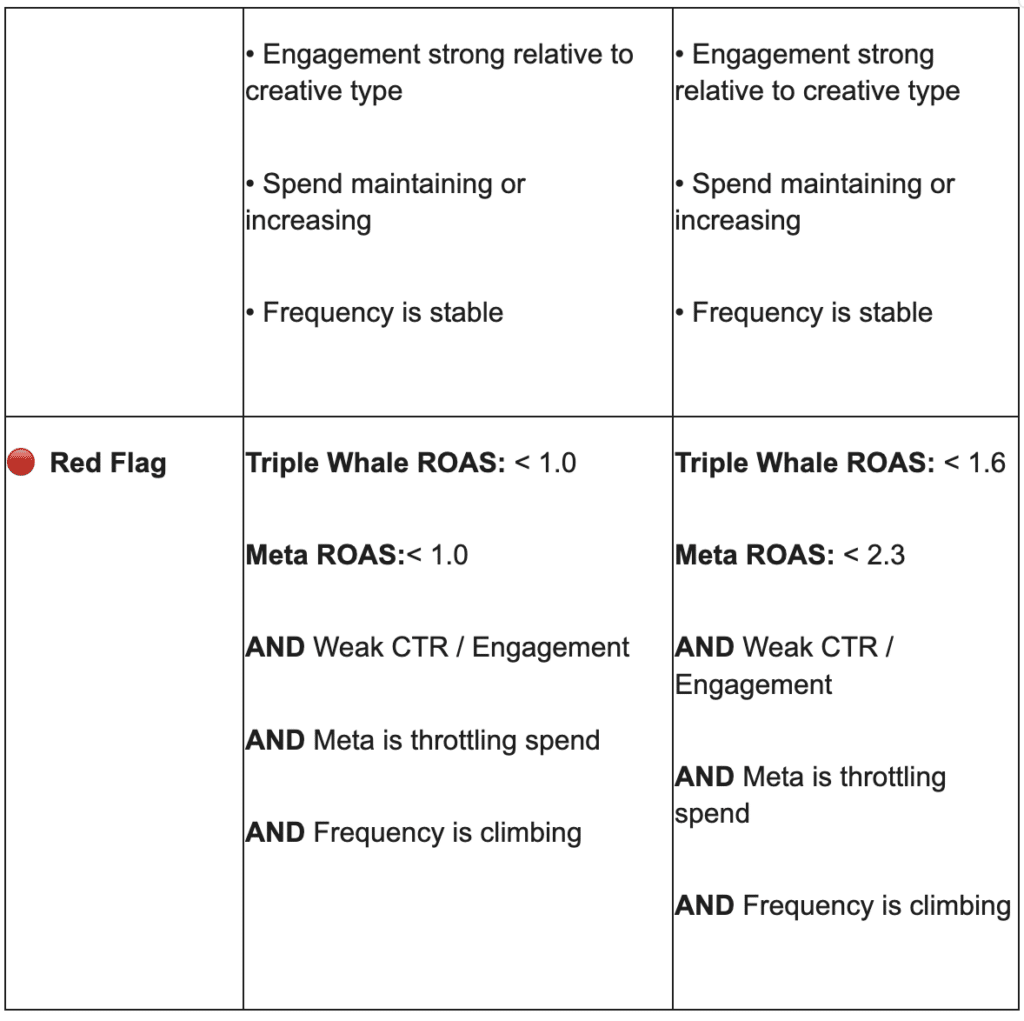
- This is the highest-confidence underperformer. If engagement is also weak, Meta is reducing spend, and frequency is climbing, that is when pausing becomes the most defensible decision.
One Important Measurement Note
Do not overreact to very fresh data when using Triple Whale Clicks & Deterministic Views. Triple Whale says view data refreshes daily, and current-day views are not included. That means view-heavy or upper-funnel ads can look weaker than they really are if you judge them too quickly.
How We Actually Use Both Systems
In practice, we use Triple Whale to judge business value and Meta to judge platform behavior. We do not pause ads based solely on ROAS. We pause when both attribution systems are weak, engagement is weak, and Meta is no longer supporting the ad with spend. That approach is more aligned with how Andromeda actually works and gives us a better way to manage creative diversity without killing ads too early.
Campaign Context Still Matters
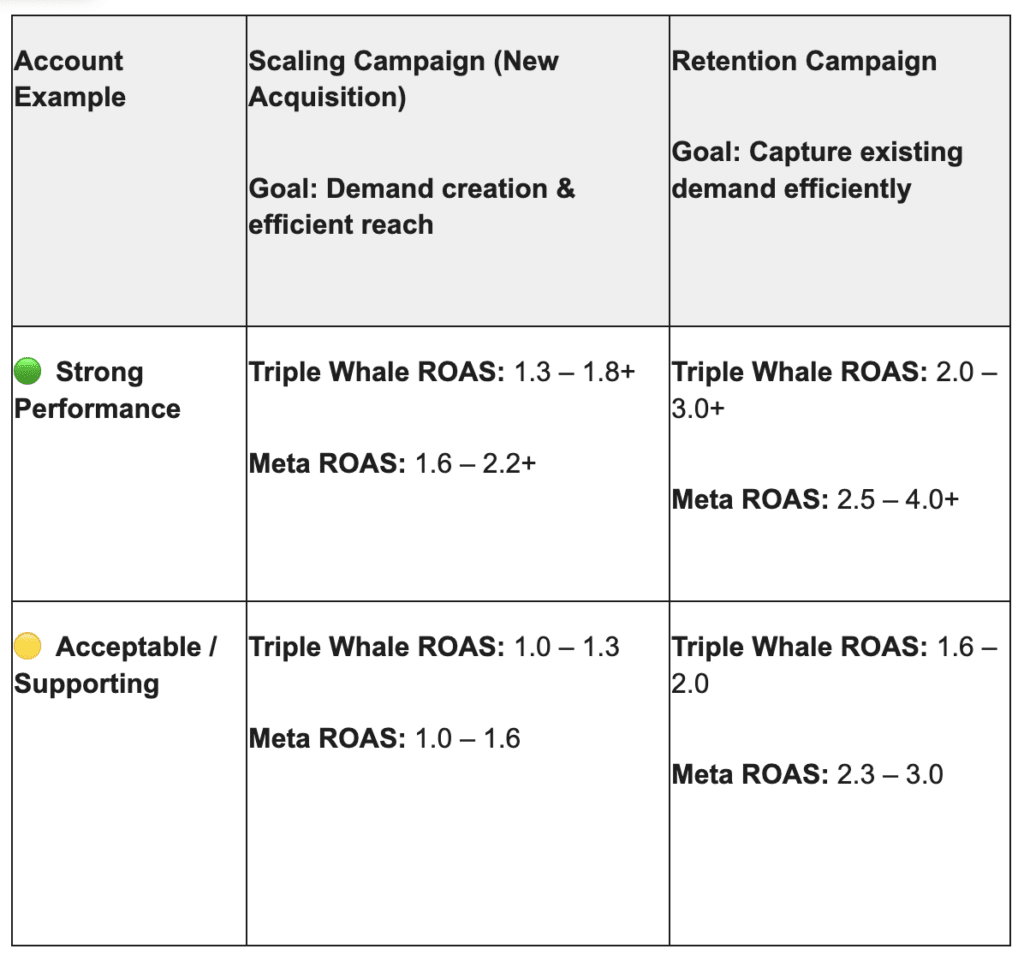
Scaling and retention campaigns serve different jobs, so they should not be judged by the same ROAS standards. Scaling campaigns can be less efficient because they are responsible for demand creation and new customer acquisition. Retention campaigns are expected to be more efficient because they are capturing demand that already exists. The goal is not to make every campaign perform the same. The goal is to make the overall system perform. Essentially, these are operating bands for Meta decision-making, not proof that every campaign or ad is profitable on a standalone basis. Below is a guide that we made for a very high-margin and successful product on Meta.
Final Thoughts
Andromeda has changed how Meta campaigns are optimized, but it hasn’t changed the goal: connecting the right message with the right person at the right time.
The biggest shift is that advertisers are no longer optimizing only for the auction. We’re optimizing for the system that decides which ads even make it into the auction in the first place.
Advertisers who simplify their account structure, invest in creative, and focus on strong signals will be better positioned to work with the system rather than fight it. In many ways, success on Meta today is less about controlling every lever and more about giving the algorithm the inputs it needs to make better decisions.
Questions?
If you have any questions or are interested in having Granular help grow your business, please use the button below to get in touch!
Related Articles